Shipwrecked of Reason Half a Century in Cuban Art
Cuban fine art is an exceptionally various cultural blend of African, Due south American, European, and North American elements, reflecting the diverse demographic makeup of the isle. Cuban artists embraced European modernism, and the early part of the 20th century saw a growth in Cuban avant-garde movements, which were characterized by the mixing of modern artistic genres. Some of the more than celebrated 20th-century Cuban artists include Amelia Peláez (1896–1968), best known for a series of mural projects, and painter Wifredo Lam (December eight, 1902 – September xi, 1982), who created a highly personal version of modern primitivism. The Cuban-born painter Federico Beltran Masses (1885–1949), was renowned as a colorist whose seductive portrayals of women sometimes made overt references to the tropical settings of his childhood.

In Centro Habana, a pocket-size neighborhood of artists have transformed the walls around them. October 2002
Better known internationally is the work of photographer Alberto Korda, whose photographs post-obit the early on days of the Cuban Revolution included a picture of Che Guevara which was to become 1 of the virtually recognizable images of the 20th century.
At that place is a flourishing street art movement influenced by Latin American artists José Guadalupe Posada and the muralist Diego Rivera.
After the Cuban Revolution of 1959, some artists felt information technology was in their all-time interests to go out Republic of cuba and produce their art, while others stayed behind, either happy or but content to be creating art in Cuba, which was sponsored by the government. Because information technology was state-sponsored, unsaid censorship occurred, since artists wouldn't want to make art that was confronting the revolutionary movement every bit that was the source of their funding. It was during the 1980s in which art began to reflect true uninfluenced expression. The "rebirth" of expression in Cuban art was profoundly affected by the emergence of a new generation of Cuban, which did not think the revolution straight.[1]
In 1981 Cubans saw the introduction of "Volumen Uno", a serial of one-homo exhibitions featuring contemporary Cuban artists. Three years later, the introduction of the "Havana Bienal" assisted in the farther progression of the liberation of art and free speech therein.[2]
Colonial Era [edit]
Throughout most of its 400 years under Spanish rule, Cuba and specifically Havana functioned as the primary entrepôt of Spain'due south empire in the Americas, with a population of merchants, administrators, and professionals who were interested in supporting the arts. In the 16th century, painters and sculptors began arriving from Europe to decorate Cuban churches and public buildings. By the mid-1700s, native-built-in artists working in the European tradition were agile in Cuba.[3] [4]
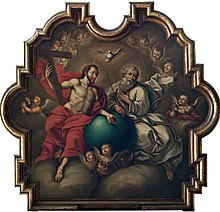
Yeyo Yeyo, José Nicolás de Escalera, ca. 1770. Drove of the National Museum of Fine Art, Havana.
The first of these to exit a substantial, identifiable body of piece of work was José Nicolás de la Escalera (1734 – 1804). Though more often than not absent-minded of originality, his religious scenes - peculiarly those decorating the cupola and altar of the Church of Santa María del Rosario near Havana - are spectacular, and include the first fine fine art depictions of Blackness Cuban slaves.[five] [three]
Vicente Escobar (1762 - 1834) was a mestizo whose skill every bit a portraitist made him pop amidst Cuba'south aristocracy.[six] Though having no formal art education himself, he opened what was perhaps Cuba'due south first painting workshop/studio, and later graduated with honors from the Real Academia de Bellas Artes de San Fernando in Madrid. His portraiture was firmly in the European Classical mode but had a distinctive freshness and energy.[vii]
A slave defection culminating in neighboring Haiti's declaration of independence in 1804 proved something of a windfall for Cuba, as refugee plantation owners and their slaves relocated to the underdeveloped, underpopulated eastern portion of the isle. However, the success of Toussaint and Dessalines' slave uprising spread intense feet throughout the Caribbean, and ane response to information technology was the growth of costumbrismo - realist however romanticized views of mean solar day-to-mean solar day life - in Cuban fine art.[4]

Tipos y Costumbres de la Isla de Cuba, Victor Patricio Landaluze, 1881.
A leading early on artist in this genre was Castilian-born Víctor Patricio de Landaluze (1830 - 1889), whose paintings depicted plantation life as rough but essentially natural and harmonious. His political cartoons for the magazine El Almendares took a more satirical view of the urbanized "Creole elite". Opposed to Cuban independence, Landaluze somewhen fell out of favor with the public, but his work remains valued for capturing the atmosphere and attitudes of his fourth dimension.[8] [iii] [4]
On January 11, 1818, the Escuela Nacional de Bellas Artes (known as the "Academy San Alejandro", in honor of an important founder/benefactor) was established in Havana, nether the direction of Frenchman Jean Baptiste Vermay (1786 - 1833). The oldest art university in Latin America, information technology is the 2d-oldest institution of higher education in Cuba, after the University of Havana. Continuing to the present day, it has produced many of Cuba's most important artists.[nine]
By the later 19th-century landscape painting had become popular, with artists such every bit Miguel Arias Bardou, Guillermo Collazo, José Abreu Morell, and José Joaquín Tejada creating scenes featuring Cuba's lush natural environs. Despite the beneficial content of their work, many artists (perhaps nearly prominently, Collazo) were stiff supporters of Cuban independence, and some were forced into exile.
In 1898 Spain's 4 centuries of rule over Cuba came to an stop when U.Due south. troops intervened on the side of rebel fighters. Independence, yet, proved illusory, with the United States controlling Cuba'southward foreign policy and much of its economy,[10] while stiff-man presidents did niggling to foster freedom and democracy. Artists of the early Republican era continued much as before, painting landscapes and scenes of Cuban life in the traditional European style, some of them showing light touches of Impressionism. Many, such as Antonio Sanchez Araujo, Armando Menocal, Antonio Rodriguez Morey, Domingo Ramos Enriquez, and Leopoldo Romañach, went on to become instructors or administrators at the Academy San Alejandro and other arts institutions. The Modernist movements which convulsed European fine art early in the 20th century initially had little impact on the closed, academic world of gimmicky Cuban art.[three]
Vanguardia artists [edit]
In the late 19th century, landscapes dominated Cuban art and classicism was nonetheless the preferred genre.[11] The radical artistic movements that transformed European art in the kickoff decades of the century arrived in Latin America in the 1920s to form part of a vigorous electric current of artistic, cultural, and social innovation.[three]

¿Quiere Mas Café Don Nicolas?, Antonio Gattorno, ca. 1938.
Past the belatedly 1920s, the Vanguardia artists had rejected the conventions of Cuba's national art academy, the Escuela Nacional de Bellas Artes "San Alejandro", in Havana, which most of them had attended. In their determinative years, many had lived in Paris, where they studied and absorbed the tenets of Surrealism, Cubism, and modernist Primitivism. Modernism outburst on the Cuban scene as part of the critical motility of national regeneration that arose in opposition to the dictatorship of Gerardo Machado, American neo-colonial command, and the consequent economic crisis.[12] They returned to Cuba committed to new artistic innovation and keen to cover the heritage of their island. These artists became increasingly political in their ideology, viewing the rural poor every bit symbols of national identity in dissimilarity to the ruling elite of post-independence Cuba. Vanguard leader Eduardo Abela, a painter who studied in Paris, was typical of the move. He discovered his homeland Cuba from abroad, apparently motivated past a combination of distance and nostalgia. On his return, Abela entered a highly productive catamenia of piece of work. His murals of Cuban life were complemented by cartoons which became social critiques of Cuban life under the disciplinarian Machado government.[13]
Pioneers of the movement included Abela, Antonio Gattorno, Victor Manuel, Fidelio Ponce de León, and Carlos Enríquez Gómez. Born around the plow of the century, these artists grew upwards amidst the turmoil of constructing a new nation and reached maturity when Cubans were engaged in discovering and inventing a national identity. They fully shared in the sense of confidence, renovation, and nationalism that characterized Cuban progressive intellectuals in the second quarter of the twentieth century.
Antonio Gattorno (1904 - 1980) and Eduardo Abela (1889 - 1965) were the primeval painters of their generation to adapt modern European and Mexican art to the estimation of their Cuban subjects. They also found in the directness and idealization of early Renaissance painting an effective model for their expression of Cuban themes. These painters' criollo images, for all their differences, shared a modern primitivist view of Cuba equally an exotic, timeless, rural land inhabited by unproblematic and sensual, if also sad and melancholic people. Although rooted in Cuba's natural and cultural environment, the vision of lo Cubano (the Cuban) was far removed from contemporary historical reality. Instead, it was based on an platonic conception of Patria that had been a component of Cuban nationalism and art since the nineteenth century.[3]
This idealized vision featured strongly in the portraits and landscapes of Victor Manuel (1897 - 1969), who was particularly impressed by the works of Paul Cézanne and Paul Gauguin during his two relatively cursory stays in Paris. A San Alejandro graduate highly skilled in drawing and limerick, Manuel chose to use primitivist simplicity to his Cuban subjects - a favorite being the female confront - and brought out qualities of melancholy and force, equally captured in La Gitana Tropical (The Tropical Gipsy, 1929), which is considered by critics to exist one of the defining pieces of Cuban Avant-garde art.[3] [14]
The emphasis which Carlos Enríquez (1900 - 1957) and Fidelio Ponce (1895 - 1949) placed on the themes of change, transformation, and decease accept had an enduring impact on Cuban art.[15] Enríquez and Ponce represent two approaches to expiry: the commencement marked by exuberant flight and emotion; the 2d by moody contemplation. If Enríquez painted the delirium after the triumphed siege, Ponce painted the anteroom of grief. Enriquez was a self-taught painter from a wealthy family, while Ponce, though he had attended the San Alejandro Academy, spent his life in poverty. What these two most original and distinctive of the Vanguardia painters had in common - aside from astringent problems with alcoholism - was the fact that neither had studied in Europe.[3]
Early on in 1927, solo exhibitions were held for Victor Manuel and Antonio Gattorno at Havana'due south Association of Painters and Sculptors, followed in May past the First Exposition of New Fine art, a group bear witness featuring mostly Cuban modernists. Trumpeted by the avant-garde periodical Revista de Avance, these well-received shows were important strides towards the acceptance of mod art in Cuba.[iii]
The masters of the get-go generation of Cuban modernism set the phase for the prevalence of certain themes that would govern Cuban fine art afterwards 1930, and which would take varying degrees of touch on on those generations that would afterward emerge entirely in exile after 1960. Between 1934 and 1940, and nevertheless reeling from the overthrow of Machado, Republic of cuba was searching for its cultural identity in its European and African roots. The landscape, flora, brute, and lore of the isle, likewise as its peasants - the frequently neglected foundation of Cuba'due south soul and economy - emerged in its art.[fifteen]
Wifredo Lam (1902 - 1982), a Cuban of Chinese, Spanish, and African ancestry, had niggling direct involvement with the Havana Vanguardia, but was of the same generation and had similar motivations and experiences with his fine art. After attention the San Alejandro Academy, he initially took the more traditional route of studying in Madrid, and lived and worked in Espana for many years. After serving in the Spanish Ceremonious War, he fled to Paris, where he came under the wing of Pablo Picasso, who kindled Lam'southward interest in African sculpture. Lam also befriended the Surrealist poet/philosopher André Breton. Returning to Cuba in 1941 after two decades abroad, Lam was enchanted, dismayed, and powerfully inspired by his homeland. He quickly developed his mature way, which incorporated elements of Cubism, Surrealism, and African art, along with imagery of the Santeria rituals he'd grown upward effectually. In 1943 he painted The Jungle, which is considered to be amidst the masterpieces of Cuban art.[16] [iv] [3]
Amelia Peláez (1896 - 1968) was the sole major female artist of the Vanguardia. A San Alejandro graduate, she studied and worked for several years in Paris, where, before her return to Havana in 1934, she captivated the influence of Henri Matisse and, particularly, the Cubism of Pablo Picasso and Georges Braque. During her long career, she worked in a diversity of media, including painting, pottery, and mosaic, and explored a multifariousness of subjects and themes, but whether creating her abstracted still life paintings or her famed big calibration public murals, her work consistently employed bright color and elaborate limerick, too every bit representations of Cuba'south tropical flora and Havana's ubiquitous Spanish Colonial architectural motifs. For all its colorful energy, even so, French critic Francis de Miomandre sensed in her work "a closed, completely enigmatic earth, haunted by an enigmatic silence." She, Lam, and Enriquez accept come to be considered Cuban fine art's about distinctive and definitive stylists.[3] [17] [4]
By 1935 the Vanguardia was recognized in Cuba as an important cultural strength and began to gain considerable notice internationally. Major exhibitions of Cuban modern art were held in the United States and throughout Latin America in the late 1930s and 40s. Wrote Albert H. Barr, Jr., organizer of the Cuban Modern Painting exhibition at New York's Museum of Modern Art in 1944, "Nosotros may be grateful for that reckless exuberance, gaiety, candor, and love of life which the Cuban painters show perhaps more than the artists of whatever other schoolhouse."[3]
Modern Cuban art was at terminal seen in Paris, France, in an exhibition at the Musée National d'Art Moderne in 1951.[3]
The artists themselves saw piffling material benefit from the growth of involvement in modernistic Cuban art. Occasional purchase awards were doled out, as at the First National Salon of Painting and Sculpture in 1935, merely there was no consistent system of patronage, and commissions for Cuba's avant-gardists were rare. Virtually subsisted on depression-paying pedagogy jobs and commercial work; a few, such as Enriquez and Pelaez, had ways of back up via their families, and some, such as Ponce and Manuel, lived in poverty.[three] The simply ane of them to eventually control high prices for his work while still living was Wifredo Lam.[16]
Other notable artists of the original vanguardia were Jorge Arche, Marcelo Pogolotti, Aristides Fernandez, Rafael Blanco, Domingo Ravenet, Alberto Peña, and Lorenzo Romero Arciaga. The 2nd National Salon of Painting and Sculpture in 1938 brought to the fore a second generation of modernistic artists which included Cundo Bermudez, Mario Carreño, Rita Longa, Alfredo Lozano, Luis Martinez-Pedro, and René Portocarrero[iii]
By the late 1940s, the first generation of vanguard artists had dispersed, pursuing their individual careers. Lam went on to corking success, living mainly in Paris subsequently 1952.[xvi] Arche, Fernandez, and Peña died immature; Enriquez and Ponce both achieved some international recognition earlier dying in middle-age. Others, such every bit Gattorno and Pogolotti, left Cuba and took their art in entirely new directions; however more emigrated subsequently the Cuban Revolution of 1959, which left Cuban artists isolated from fine art developments and markets in the United states and Europe. Several, such equally Pelaez, Abela, and Manuel, continued to produce work in Cuba.[iii]
The Vanguardia artists received international recognition in 2003 with the Modern Cuban Painting exhibition at the Museum of Modernistic Art in New York, later shown in Paris.[eighteen] Modern Cuban artists continue to do meaning work in this tradition, including Juan Ramón Valdés Gómez (chosen Yiki) and José Toirac.
Naïve fine art [edit]

According to European and North American Art critics, Naïve art is unremarkably recognized by its childlike freshness and non-expert qualities,[19] such as lack of accurate perspective, little or no modeling, and assuming coloration.[20] Artists who work in this style are generally acknowledged every bit favoring a more "primitive" or "folk" style of fine art.[21] The term naïve itself can be problematic; usually meaning an creative person is self-taught, it has been used in the by by bookish artists or critics as a derogatory term, since naïve artists tend to ignore the basic rules of art. Despite their disregard for bookish conventions, naïve artists are oft quite sophisticated in their personal forms of artistic expression.
The colors used in Cuban naïve fine art are especially bright, with artists using the vibrant hues of their tropical home to present an idealized view of rural life, with spiritual references to Catholicism and Santeria'due south Orichas (deities), legends, and other aspects of Afro-Cuban civilization, past and present. This naïve style of art portrays the typical Cuban worldview of the enjoyment of life despite its hardships[20]
In the 1950s, American tourism in Republic of cuba created a swell demand for folkloric and picturesque art, leading to increased product of what came to exist known as "tourist fine art", almost of which was classified as naïve.[22] At the fourth dimension this art was seen as a "astern, barbaric, and crude form of expression that must exist swept abroad," rather than an accurate representation of a living civilisation.[23] Afterward the Cuban Revolution of 1959, educational, cultural, and artistic activities were encouraged, with artists able to nourish the nation's free-access fine art schools (Escuelas Nacionales de Arte—now known equally Instituto Superior de Arte). Even then, whether due to concrete isolation or disinterest in the world of academic painting, there remained a large number of self-taught Ingenuous or Spontaneous painters. Many of these artists joined together to form the Motility of Popular Artists in the early 1960s. Although this and other cooperative efforts waned over the post-obit decades, the artists themselves continued to pigment.[24]
Due to Cuban national pride in academic accomplishment and artistic grooming, it had been considered demeaning to be called a naïve artist in the early on years afterwards the Revolution. Since naïve artists were not by and large recognized by the regime equally professional artists, they were not taken seriously by the arts community at large and were at times harassed, their art sales being claimed illegal activity past the Cuban government.[25] In the late 20th century, nonetheless, this attitude began to modify.
In 1997, Sandra Levinson, executive director of the Heart for Cuban Studies Art Space in New York Metropolis, organized Naïve Art in Cuba, a first-of-its-kind exhibition at the Metropolitan Arts Middle featuring the art of fourteen Cuban naïve artists, in addition to the eight members of the Grupo Bayate artist's commonage from Mella, Santiago de Cuba. These artists were discovered during a 1996 trip to Cuba by Levinson, Olga Hirshhorn, and others, who crisscrossed the island searching for examples of this style of art, of which so piffling had previously been seen in the United states of america[twenty]
The unofficial head of Grupo Bayate is Luis Rodríguez Arias (built-in 1950), a bakery by profession. He is known as el maestro to differentiate him from his son, artist Luis Rodríguez Ricardo (born 1966), who calls himself el Estudiante. Both were represented in the Naïve Art from Cuba exhibition, which ran from September 11 to October 10, 1997.[20]
Luis El estudiante Rodriguez is among the most prominent Cuban Naïve painters. He began painting at xviii years of age; he has described his first painting, of a girlfriend's abode, as "horrible".[26] Later on serving in the army and working in construction, he was assigned to subcontract labor during Cuba's "special menstruum". In those years he began to work with sculpture as a way to supplement his income, turning to paint a few years afterwards.[27] Like virtually naïve artists, he finds inspiration for his work in the experiences of his daily life: religious rituals and the events and people of his community. Having grown upwards in a neighborhood of mostly Haitian families, he is well aware of their struggles; he sometimes describes his work as "polemic".[27] In January 1997, el Estudiante held a i-man show in Santiago de Cuba's largest and most prestigious gallery, Oriente, and continues to accept part in exhibitions held by Grupo Bayate. In June 2002 his work was described as "riotously colorful and stacked like a rush-hr railroad train" in a New York Times article entitled "Ebullient Cubans Make a Lot Out of a Little",[28] which also speaks of the art-market success of his naïve fashion.
Another creative person featured in the 1997 Metropolitan Arts Middle'due south Naïve Art from Republic of cuba exhibition was Julián Espinoza Rebolledo, too known as Wayacón. Born in 1931 (although his birth was not registered until 1941, making him "officially" 10 years younger than he really is), Wayacón began painting equally a kid. Attending school but through the third grade, this self-taught artist supported himself equally a builder, auditing courses at the Cuban academy when he was older. In the 1950s he joined the Signos artists' grouping and participated in his first exhibitions in Japan and Switzerland.[29] Although an admirer of Miró, Chagall, Degas, and Picasso, his greatest inspirations come up from observing the practice of the Santeria faith.[xxx] Many of his paintings testify their influence, containing brilliant colors and religious imagery, with an almost hallucinogenic quality.[20]
The foremost naïve artist in Cuba is José Rodríguez Fuster, known equally Fuster. In addition to his paintings and drawings, he has over the years transformed the poor suburb of Jaimanitas, Havana, into a magical, dreamlike streetscape, drawing on his expertise as a ceramist to create an environment evocative of Antoni Gaudi's famed Park Güell in Barcelona. There is a chess park, with giant boards and tables, houses individually decorated with ornate murals and domes, a riot of giant roosters, gauchos, Afro-Cuban religious figures installed by the archway of many houses, a Fusterised theatre, public squares, and a large landscape.
The archaic-outsider art of Corso de Palenzuela (b. Havana, ca.1960), a self-taught painter of Sephardic beginnings, taps a rich lode of memory for its source material, depicted in a very personal Cuban landscape. Although he emigrated to the U.S. with his family at the age of 8, his colorfully vivid workplaces keen emphasis on bringing out the rich cultural heritage of his native country.[31]
Although not technically a naive artist, Manuel Mendive is perhaps the single most of import exponent of contemporary Afro-Cubanismo in the visual arts. Born in 1944 into a Santería-practicing family, he graduated from the prestigious Academia de Artes Plásticas San Alejandro in Havana in 1962 with honors in sculpture and painting.
Few naïve artists have been represented in either Contemporary Art Salons or the Biennial of Havana. However, with growing interest in the genre, at that place are, as of 2015, increasing numbers of academic artists who take begun to paint in this style, with greater representation for all.[32]
Fine art in Post-Revolutionary Republic of cuba [edit]
In the 1960s the aftermath of the Cuban revolution brought new restrictions, causing an exodus of intellectuals and artists. The new régime required "a exercise of culture as ideological propaganda, forth with a stereotyped nationalism".[33] Although regime policies - driven by limited resources - did narrow artistic expression, they expanded, through didactics and subsidies, the number of people who could practise art, breaking downwardly barriers through democratization and socialization. The increasing influence of the Soviet Union in the 1960s and 1970s did impact Cuban culture, but the Cuban government did not match the U.S.S.R in its caste of control over the Arts.[33]

Ché poster, 1968, designed by Alfredo Rostgaard, based on a photograph by Alberto Korda. The poster was distributed in OSPAAAL'due south magazine Tricontinental.
In the 1960s regime agencies such equally the Committee of Revolutionary Orientation (the publishing partition of the Cuban Communist Party, later renamed Editora Politica (EP)) and OSPAAAL began churning out posters for propaganda purposes. Many of these used stereotypically Soviet design features, simply even some early samples showed hints of the Cuban flair for colorful and inventive graphic design, and by the late 60s, Cuban graphic art was in its heyday. Though still essentially producing propaganda, artists such every bit Rene Mederos, Raul Martinez, Alfredo Rostgaard, and Félix Beltran were creating vivid, powerful, and highly distinctive works which had a global influence on graphic design.[34] [35]
An paradigm commonly used by Cuban graphic designers was "Guerillero Heroica", a photograph of Ché Guevara taken past Alberto Korda (b. Havana, 1928 – d. Paris, 2001). The candid shot of a moody exhausted Guevara, taken in March 1960 at a memorial service for victims of an ammunition ship explosion in Havana Harbor, became i of the earth'due south most iconic images. It was somewhen altered and adapted for everything from mucilage wrappers to a xc ft. alpine commemorative iron sculpture in Havana's Plaza de la Revolución. Korda was a popular fashion lensman who became a devoted revolutionary and close companion of Fidel Castro, taking thousands of shots of Castro'south travels and Cuba's transformation.[36] [37]
Cubans remained intent on reinforcing a Cuban identity rooted in its ain civilisation, as exemplified by the work of Grupo Antillano.[38] The simultaneous assimilation or synthesis of the tenets of modern western art and the evolution of Afro-Cuban art schools and movements created a new Cuban culture.[ citation needed ] Art proliferated under state programs of sponsorship and employment during this post-revolutionary catamenia; the programs both politicized creative content and inspired confidence in the people within the framework of Cuba'due south reinvented nationalism. Nelson Dominguez and Roberto Fabelo went from Abstraction and Neoexpressionism of the 1950s, to immortalizing the proletariat, farmers, workers, and soldiers, while continuing to use many of the techniques they learned under the tutelage of Antonia Eiriz Vázquez. By combining nationalism with the politicization of fine art, artists maintained a level of freedom that continues to inspire innovation.[ citation needed ]
The Salón de Mayo (May Salon) was an art exhibition held in Havana in July 1967. Organized past Carlos Franqui, it presented works by more than a hundred artists and represented rival schools of twentieth-century fine art: early modernists (Picasso, Miro, Magritte); the next generation (Lam, Calder, Jacques Hérold, Stanley Hayter); and postwar (Asger Jorn, Antonio Saura, Jorge Soto.[39] It represented the high point of artistic costless expression in the decade post-obit the revolution.[40]
The new art [edit]
The 1960s and 1970s saw the introduction of conceptual fine art, shifting emphasis away from adroitness to ideas. This oftentimes meant the emptying of objects in fine art product; but ideas were stated or discussed. It required an enhanced level of participation by the patron (interactive participation or a set of instructions to follow). Conceptual art, Minimalism, Earth fine art, and Performance art mingled together to expand the very definition of Art.[41]
By the late 1970s, many of the graduates of the school of the arts in Cuba, "the Facultad de Artes Plasticas of the Instituto Superior de Arte" (founded in 1976) were going to work equally schoolteachers, pedagogy art to immature Cubans across the island. This provided a platform for the graduates to teach students about freedom of expression in medium, message, and style of art. Information technology was this new level of experimentation and expression that was to enable the motion of the 1980s.[ii]
In Cuba, these new developments were naturally synthesized through the Afro-Cuban sensibility and emerged equally The New Art, an fine art motion widely recognized equally distinctly Cuban.[ commendation needed ] Young artists born subsequently the revolution rebelled against modernism and embraced conceptual art, amongst other genres. Many would carry on folkloric traditions and Santeria motifs in their private expressions while infusing their message with humor and mockery.[33] The art took a qualitative jump by creating international art structured on African views, not from the outside like surrealism but from the inside, alive with the cultural-spiritual complexities of their own existence.
The exhibition Volumen Uno, in 1981, wrenched open the doors for The New Fine art. Participants, many of whom were still in school, created a typical generational backlash by artists of the previous generation including Alberto Jorge Carol, Nelson Dominguez, and César Leal, who went on the assail against the upstarts. The grouping, Volumen Uno - fabricated up of Jose Bedia, Lucy Lippard, Ana Mendieta, Ricardo Brey, Leandro Soto, Juan Francisco Elso, Flavio Garciandia, Gustavo Perez Monzon, Rubin Torres Lloret, Gory (Rogelio Lopez Marin), and Tomas Sanchez - presented a "fresh eclectic mix filtered through informalism, pop, minimalism, conceptualism, performance, graffiti and Arte Povera reconfigured and reactivated … to be critically, ethically, and organically Cuban".[42]
This age of artists was dedicated to people who were willing to accept risks in their fine art and truly limited themselves, rather than to express things that supported the political movement. While looking at the art of the 1980s we encounter a trend in the apply of the shape of Cuba itself as inspiration for art. Ane-slice, Immediately Geographic past artist Florencio Gelabert Soto, is a sculpture in the shape of Cuba but is broken into many pieces. 1 interpretation could reflect the still unequal treatment towards artists, and the repression they were under. A movement that mirrored this artistic piece was underway in which the shape of Cuba became a token in the artwork in a phase known as "tokenization". This artwork oft combined the shape of the island of Cuba with other attributes of the nation, such as the flag. By combining the various symbols of Cuba the artists were proudly proclaiming 'this is who nosotros are'. Some art critics and historians however will argue that this was partially due to the isolated nature of the isle, and that use of the island in artwork represented a feeling of existence alone; as with all fine art, the intention of the creative person tin can take many interpretations.[43]
Past the middle of the 1980s, another group of artists sought a more than explicit political responsibility to "revive the mess", "revive the confusion", every bit Aldo Menendez incorporated into his 1988 installation. Accompanying Menéndez'due south installation was a notation: "As you lot can see, this piece of work is about blank. I could just start it due to the lack of materials. Delight help me." Hither is the Cuban humor, the photo, "perhaps the virtually quintessentially Cuban expression".[42]
Laughter became the antidote of anarchistic energy for and from the revolution; "one moment an ambitious undertow, then a jester's provocation, pressuring the tensions", wrote Rachel Weiss in To and from Utopia in the New Cuban Art.[42] "The photo is allergic to authority and prestige, the enemy of society in all its manifestations…civil disenchantment, the incredulous and mocking inner nature of the Cuban rises to the surface."[42] The photo, doing abroad with exactitude, tends to depict the extreme limits of an example. This sardonic Cuban humor has become as ubiquitous in Cuban art as the bright Caribbean colors of its palette. Eduardo Ponjuan, Glexis Novoa (of the ABTV grouping), Carlos Rodriguez Cardenas, Carlos Garaicoa, René Francisco and Enrique Silvestre[44] are exemplars of this sensibility, mixing it with kitsch and harkening back in time while identifying with current Cuban attitudes, liberating art on the eve of the Cuban 'special catamenia', in which the Soviet Union withdrew its fiscal aid.
In 1990 the Cuban authorities began programs to stimulate the tourist merchandise as a ways of offsetting the loss of Soviet back up. In 1992 the constitution was amended[ by whom? ] to allow and protect foreign-owned property, and in 1993 the dollar was permitted to broadcast legally. In 1994 a cabinet-level department was created, the Ministry building of Tourism, to further enhance tourism, which is Republic of cuba'south largest source of income.[42] The initial reaction of the artists, as well as the general population, was withdrawal; "Withdrawal from the public to the individual…from the collective to the private…from the epic to the mundane…from satire to metaphor...Withdrawal from controversy…withdrawal from confrontation".[42] But information technology was the withdrawal from conceptual to figurative fine art that divers the modify in painting. Due in large measure to the interest of tourists, art took on higher-visibility, as well as returning to a more figurative mode of expression. Art likewise worked every bit space where Cubans debated some of the social problems magnified past the "Special Period", as illustrated by the Queloides art project, which deals with issues of race and bigotry.[45]
"Every Cuban is an artist and every home is an art gallery," wrote Rachel Weiss in To and from Utopia in the New Cuban Art.[42]
Political influences in Cuban fine art [edit]
"A question of major importance in Cuban culture is the link betwixt radical political and creative positions…where civilization carries a marked social edge attuned to the circumstances in which information technology is produced and where it is forced to construct a national identity in the face of colonial and neo-colonial powers."[33]
In the 1980s, when the New Cuban Art Movement was consolidating, many still hoped to institute the 3rd World utopia of social justice promised past the Cuban revolution. While Cuba shares many characteristics with other Latin American countries three factors guarantee information technology a unique placement amongst the formerly colonized countries of the Americas:
- Spain continued emigration to Cuba in large numbers until the eye of the 20th century
- The native population was eliminated in the 17th century
- Cuba possesses the most varied cultural traditions of all the African diaspora in America
"Although liberty of expression is nonexistent in Cuba, a certain corporeality of dissonance can be tolerated for recognized artists, at the right fourth dimension and the right identify, which basically means occasionally, in officially sanctioned (and controlled) venues, with very petty (if whatever) spillover in the media. This keeps everybody on his or her toes and creates tension that is useful for the state. The global market seems to like its Cuban art with a nuance of political irreverence, though many groovy works of Cuban artists sold abroad feature no obvious Cuban, Caribbean area, or Latin American style or content. Cuban artists are oft masters of double entendre and detachment (parody, irony, sarcasm, and pastiche). The regime can afford to appear moderately open-minded since this kind of art is mostly inconsequential on the island. It tin exist censored when it appears to be crossing the line, perchance leaving the artist free to present it away and to showroom some other works at home."[46]
Religious influences in Cuban art [edit]
In addition to the Christian, predominately Cosmic, four African Religions are continuing to influence culture being skillful in Cuba: Santeria (Yoruba), Palo Monte (Kongo), Regla Arara (Ewe Fon), and the secret, male-merely, Abakua (Calabar). The African religions operate independently and synthesized with each other and the Christian religions (syncretism). These unique views of reality course a cadre of practices, behavior, and customs that take shaped a cultural distinction labeled Afro-Cuban and known as the ascendant force in Cuban art; a transracial, "hybridized, inventive, and influential in the construction of contemporary [Cuban] culture".[47]
Run into also [edit]
- List of Cuban artists
References [edit]
- ^ Padura Fuentes, Leonardo. "Living and Creating in Cuba: Risks and Challenges". Reinventing the Revolution: A Contemporary Cuba Reader. Ed. Philip Brenner et al. Lanham, Doc: Rowman & Littlefield Publishers, Inc., 2008. 348–354. Impress.
- ^ a b Tonel, Antonio Eligio. "A Tree From Many Shores: Cuban Fine art in Movement". Art Journal. 57.4 (1998) 62–74. Impress.
- ^ a b c d e f yard h i j one thousand 50 k n o p Martinez, Juan A.; Cuban Art & National Identity: The Vanguardia Painters, 1927-1950; University Press of Florida, 1994; ISBN 0-8130-1306-two
- ^ a b c d eastward Poupeye, Veerle; Caribbean Fine art; Thames and Hudson Ltd., London, 1998; ISBN 0-500-20306-7
- ^ Cernuda Arte: José Nicolás de la Escalera; http://world wide web.cernudaarte.com/artists/jose-nicolas-de-la-escalera/ retvd ii half dozen 16
- ^ Art Experts; Vicente Escobar y de Flores (1762-1834); http://world wide web.artexpertswebsite.com/pages/artists/escobarydeflores.php; retvd 1 31 16
- ^ Cernuda Arte: Vicente Escobar; http://world wide web.cernudaarte.com/artists/vicente-escobar/; retvd ane 31 16
- ^ Cernuda Arte: Víctor Patricio Landaluze http://www.cernudaarte.com/artists/victor-patricio-landaluze/; retvd ane 31 16
- ^ EcuRed: School of Fine Arts San Alejandro; https://translate.google.com/interpret?hl=en&sl=es&u=http://www.ecured.cu/Escuela_de_Artes_Pl%25C3%25A1sticas_San_Alejandro&prev=search retvd 2 6 16
- ^ the U.S. Dep't of State-Office of the Historian; The The states, Cuba, and the Platt Amendment, 1901; https://history.land.gov/milestones/1899-1913/platt Archived Apr 23, 2015, at the Wayback Machine retvd 2 6 xvi
- ^ Cuban Culture Archived June 14, 2006, at the Wayback Machine.
- ^ Ades, Dawn. Art in Latin America: The Modern Era, 1820–1980. New Haven: Yale University Press, 1989: 7.
- ^ Eduardo Abela Archived July 21, 2006, at the Wayback Car Cubanet
- ^ Cernuda Art: Victor Manuel Garcia; http://www.cernudaarte.com/artists/victor-manuel-garcia/ retvd 12 9 15
- ^ a b Cruz-Taura, Graciella; Fuentes-Perez, Ileana; Pau-Llosa, Ricardo. Exterior Republic of cuba. New Bailiwick of jersey: Office of Hispanic Arts Mason Gross School of the Arts, 1988: 44.
- ^ a b c Sims, Lowery Stokes; Wifredo Lam and the International Avant-Garde, 1923-1982; University of Texas Printing, 2002; ISBN 0-292-77750-7
- ^ Cubanet-artist biography:Amelia Pelaez; http://world wide web.cubanet.org/htdocs/lee/amelia.html retvd 12 18 15
- ^ Cuban Art and National Identity: The Vanguardia Painters Juan A. Martínez
- ^ "Naïve Art". The Oxford Dictionary of Art and Artists. Ed. Ian Chilvers. Oxford: Oxford University Press. 2009. Oxford Reference Online. Web.
- ^ a b c d eastward Naïve Fine art from Cuba. New York, NY: Center for Cuban Studies. 1997.
- ^ Mouial, Gérald. "Magic Art in Republic of cuba: 51 Cuban Painters, Naïve, Ingenuous, Primitive, Pop, Spontaneous, Intuitive…" Ciudad de la Habana: Artecubano; National Council of the Visual Arts of Cuba. 2004: xv.
- ^ Mouial, Gérald. "Magic Art in Cuba: 51 Cuban Painters, Naïve, Ingenuous, Primitive, Popular, Spontaneous, Intuitive…" Ciudad de la Habana: Artecubano; National Council of the Visual Arts of Republic of cuba. 2004: ix
- ^ Fure, Rogelio Martinez. "Afrocuba: An Anthology of Cuban Writing on Race, Politics, and Civilization". Ed. Sarduy, Pedro Perez, and Jean Stubbs. Melbourne: Ocean Press. 1993: 104.
- ^ Mouial, Gérald. "Magic Art in Republic of cuba: 51 Cuban Painters, Naïve, Ingenuous, Primitive, Pop, Spontaneous, Intuitive…" Ciudad de la Habana: Artecubano; National Quango of the Visual Arts of Republic of cuba. 2004: nine.
- ^ Mouial, Gérald. "Magic Art in Cuba: 51 Cuban Painters, Naïve, Ingenuous, Primitive, Popular, Spontaneous, Intuitive…". Ciudad de la Habana: Artecubano; National Council of the Visual Arts of Cuba. 2004: nine.
- ^ Mouial, Gérald. "Magic Fine art in Cuba: 51 Cuban Painters, Naïve, Ingenuous, Archaic, Pop, Spontaneous, Intuitive…" Ciudad de la Habana: Artecubano; National Council of the Visual Arts of Cuba. 2004: 178.
- ^ a b Mouial, Gérald. "Magic Fine art in Cuba: 51 Cuban Painters, Naïve, Ingenuous, Primitive, Popular, Spontaneous, Intuitive". Ciudad de la Habana: Artecubano; National Council of the Visual Arts of Cuba. 2004: 179.
- ^ Grant, Annette. "Art/Architecture; Ebullient Cubans make a Lot Out of a Little". The New York Times (2000): 35. Academic Search Complete: 2.
- ^ Mouial, Gérald. "Magic Art in Cuba: 51 Cuban Painters, Naïve, Ingenuous, Primitive, Popular, Spontaneous, Intuitive…". Ciudad de la Habana: Artecubano; National Quango of the Visual Arts of Cuba. 2004: 82.
- ^ Mouial, Gérald. "Magic Fine art in Cuba: 51 Cuban Painters, Naïve, Ingenuous, Primitive, Popular, Spontaneous, Intuitive…". Ciudad de la Habana: Artecubano; National Council of the Visual Arts of Cuba. 2004: 85.
- ^ Gonzalez, David-"Striving to Capture Cultures and Beauty of Republic of cuba", The New York Times, July 25, 1995,
- ^ Mouial, Gérald. "Magic Fine art in Republic of cuba: 51 Cuban Painters, Naïve, Ingenuous, Primitive, Popular, Spontaneous, Intuitive…" Ciudad de la Habana: Artecubano; National Quango of the Visual Arts of Cuba. 2004: 180.
- ^ a b c d Mosquera, Geraldo. The New Cuban Art: Mail Modernism and Postsocialist Condition. Berkeley: University of California Press, 2003. 208–247, Impress.
- ^ Cushing, Lincoln; ¡Revolucion!: Cuban Affiche Art. Chronicle Books, 2003; ISBN 0811835820
- ^ Slanted Magazine #21:Cuba – The New Generation, 2013
- ^ Havana Cultura - Visual Arts - Alberto Korda, photographer; http://havana-cultura.com/en/visual-arts/alberto-korda; retvd iii 12 16
- ^ The Art History Annal - photography: Alberto Korda; http://world wide web.arthistoryarchive.com/arthistory/photography/Alberto-Korda.html; retvd 3 12 sixteen
- ^ de la Fuente, Alejandro. Grupo Antillano: The Fine art of Afro-Cuba. Pittsburgh: University of Pittsburgh Press, 2013.
- ^ Sims, Lowery Stokes (2002). Wifredo Lam and the International Avant-garde, 1923-1982 . University of Texas Press. p. 154. Retrieved Feb 12, 2016.
- ^ Wilkinson, Stephen (2006). Detective Fiction in Cuban Society and Culture. Peter Lang AG. pp. 72ff. ISBN9783039106981 . Retrieved February 12, 2016.
- ^ Morgan, Ann Lee. "Conceptual Art". The Oxford Lexicon of American Art and Artists. Oxford: 2007. Oxford University Press.
- ^ a b c d eastward f k Weiss, Rachel. To and from Utopia in the New Cuban Fine art. London: University of Minnesota Press, 2011.
- ^ Fernandez, Antonio Eligio. "The Isle, the Map, the Travelers: Notes on Recent Developments in Cuban Art". Purlieus 2. 29.3 (2002) 77–90. Print.
- ^ Memoria : Cuban fine art of the 20th century. Veigas, José. Los Angeles, CA: California/International Arts Foundation. 2002. p. 337. ISBN0-917571-xi-8. OCLC 50848031.
{{cite book}}: CS1 maint: others (link) - ^ de la Fuente, Alejandro. Queloides: Race and Racism in Cuban Contemporary Art. Pittsburgh: Mattress Factory, 2011.
- ^ Yvon Grenier, Culture and the Cuban State; Participation, Recognition, and Noise under Communism (Lexington Books, 2017)
- ^ Mosquera, Geraldo. The New Cuban Art: Mail Modernism and Postsocialist Status. Berkeley: University of California Press, 2003. 208–247.
External links [edit]
- Wealth-Of-Art observe gimmicky artworks from emerging Cuban artists in London
- Contemporary Cuban Fine art Gallery in Miami from Luis Miguel Rodriguez
- Authentic Cuban Art
- Gimmicky Art from Republic of cuba
- Cuban poster collection, The Bancroft Library
- Cuban Fine art in Boston
- The Ediciones Vigía Collection From the Rare Book and Special Drove Sectionalization at the Library of Congress
Source: https://en.wikipedia.org/wiki/Cuban_art
0 Response to "Shipwrecked of Reason Half a Century in Cuban Art"
Post a Comment